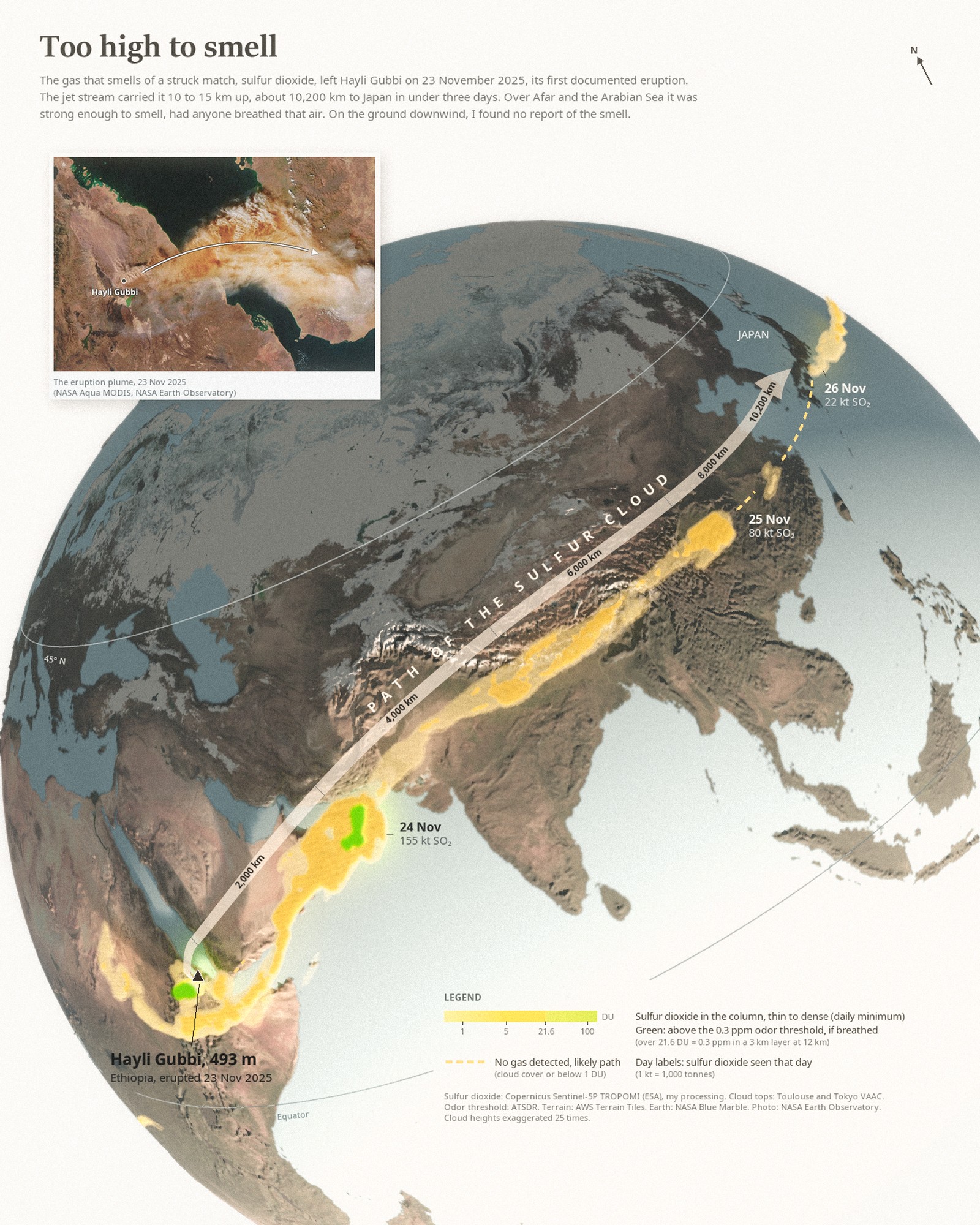
Day 19 is Smell. On 23 November 2025, Hayli Gubbi, a volcano in the Afar region of Ethiopia, had its first documented eruption. It threw out sulfur dioxide, the gas that smells of a struck match, and most of it rose to 10 to 15 km. The jet stream took it east. Within about 68 hours it was over Japan, after roughly 10,200 km along its path, or 9,600 km on a great circle to Osaka.
So could anyone have smelled it? Most people notice sulfur dioxide from about 0.3 ppm. If the gas is spread through a 3 km thick layer, the air inside the cloud passed that line only over Afar on the first day and in a small core over the Arabian Sea on the second. Even there, 12 km up, the air is about five times thinner, so it would only have smelled that strong if brought down to breathing pressure, as in an aircraft cabin. From India to Japan it stayed well below. On the ground I found no report of the smell anywhere downwind, and Oman’s Environment Authority recorded no rise in pollutants. It crossed Asia too high and too thin to smell.
The breaks in the yellow band are not breaks in the gas. They are places where the satellite detected no gas: weather clouds hid it, or the column was below 1 Dobson unit. For the same reason the daily amounts are minimums; on 25 and 26 November I count only the cloud on its way east, not the leftovers near Africa.
Method
I built daily sulfur dioxide grids (0.1 degree) from the Sentinel-5P TROPOMI orbits and set each day’s cloud at the top height the Toulouse and Tokyo volcanic ash advisory centers reported near the time of the satellite pass. The in-cloud ppm assumes a 3 km layer around 12 km (US Standard Atmosphere). The vent in the photo inset is marked approximately. The globe and the cloud were rendered in 3D in Blender, with heights exaggerated.
Sources
- Copernicus Sentinel-5P TROPOMI SO₂, offline Level 2 (ESA), November 2025; daily grids are my processing.
- Volcanic ash advisories: Toulouse VAAC (Météo-France) and Tokyo VAAC (Japan Meteorological Agency), 23 to 26 November 2025.
- Odor threshold: ATSDR, Medical Management Guidelines for Sulfur Dioxide.
- Relief: AWS Terrain Tiles. Base image: NASA Blue Marble.
- Photo inset: NASA Earth Observatory, Aqua MODIS, 23 November 2025.